“If
you could see the pilot smile, and he waved out of the window,
then it had to be those crazy ‘spooks’ from the 138th.” – Tom
Berger, Vietnam Veteran
The
first pre-production aircraft were started in 1949. The Model 50's type certificate
was awarded in 1952, entering production as a utility transport for the U.S.
Army. It was also the first twin-engine aircraft in its class to be offered
to the business market.
The Army adopted
the Twin Bonanza as the L-23. During an initial demonstration
flight for the Army,
a Twin Bonanza crashed while trying to take off over a 50 foot tree
line while full of soldiers and sandbags. Everyone involved walked
away from the crash.
The Army was impressed with the structural strength of the Twin Bonanza,
later purchasing approximately 500 of the 729 airframes produced.
This
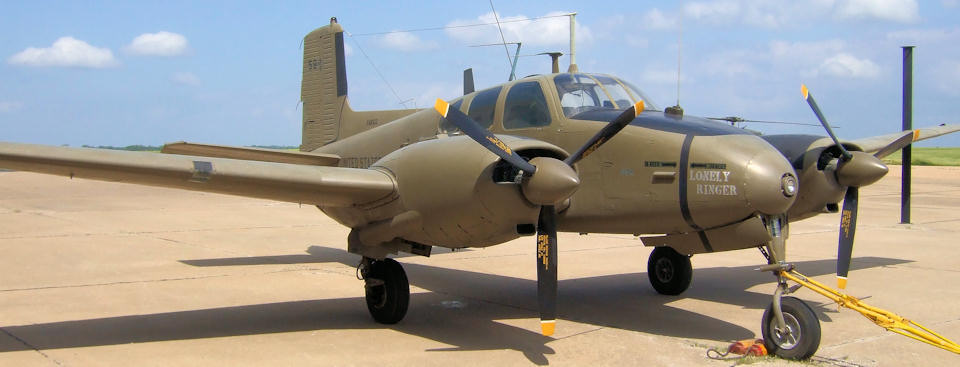
aircraft flew electronic intelligence (ELINT) gathering missions
in the skies over South Vietnam and Laos with the US Army 138th Aviation
Company/224th Aviation Battalion from the summer of 1966 until 1972.
This plane was one of eight RU-8Ds flown by the 138th out of Da Nang, South
Vietnam. The mission of the 138th was to provide support to the US
Marine Corps in the form of ELINT gathering, intercepting enemy radio
transmissions to locate their troop concentrations and movements
and locating enemy transmitters. That is why the aircraft is covered
with antennas. The planes and pilots were called “spooks,” Vietnam
slang for intelligence types.
Mr.
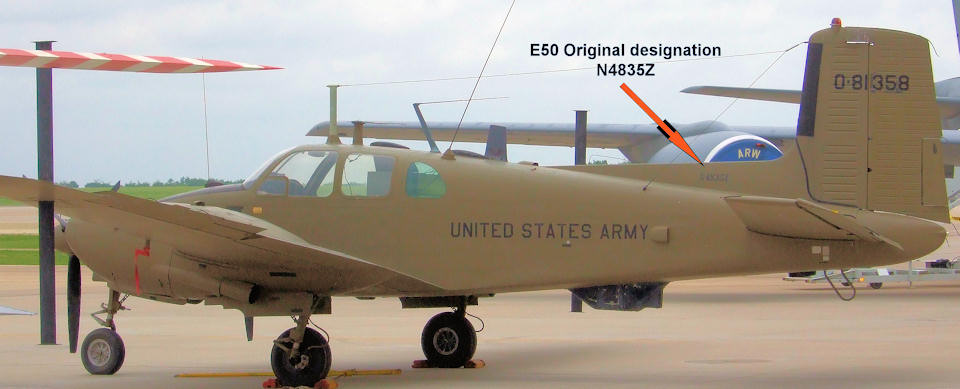
Bruce Clapham donated USAF 58-1358 to the Combat Air Museum in May 1985.
He found the aircraft in a salvage yard in Tucson, Arizona in
1983 and restored the
remains back to its Vietnam configuration under the FAA Reg. No. N4835Z.
Mr. Clapham originally flew USAF 58-1358
as a Warrant Officer
with the US Army 138th Aviation Company/224th Aviation Battalion in
Vietnam, 1966-1967.
The callsign "Lonely Ringer" was assigned to the 224th Aviation Battallion (RR) which included the 1st RR, the 138th, 144th, 146th and 156th Avn. Companies (RR). The RU-8Ds had no armament and
no armor protection. The brass plate on the right fuselage on this model is dedicated
to four members of the 138th Aviation
Company killed in action in Vietnam. The brass
plate on the left side
of the nose is dedicated in the memory of Bruce Clapham, who passed
away in 1989.
USAF 58-1358 was delivered to the US Army 16 February 1959 as an L-23D and
modified to an RL-23D. It was re-designated RU-8D in 1962. It has been preserved and displayed at the Combat Air Museum since May 1985.
Year removed from service -- 1980
| TECHNICAL
NOTES: |
|
| Manufacturer: |
Beech Aircraft Company, Wichita, Kansas |
| Basic Role: |
Twin-engine electronic intelligence (ELINT) platform |
| Crew: |
Pilot, co-pilot, intercept operator |
| Engines: |
Two 340 HP (254kW) Lycoming O-480-1 Piston Engines |
| Maximum speed: |
233 mph (376km/hr) |
| Cruising Speed: |
180 mph
(290km/hr) |
| Max. Range: |
1,350-1,470 miles |
| Service Ceiling: |
27,000 ft (8,229 m) |
| Range: |
1350 – 1470 miles (2,177 – 2,371km) |
| Wingspan: |
50 ft. 2.375 in (15.3m) (Extended Wing Tips) |
| Length: |
31 ft 6.469 in (9.6m) |
| Height: |
11 ft 6.5 in (3.52m) |
| Weight (empty): |
4,970 lb. (2,254kg) |
| Weight (gross); |
7,400 lb. (3,357kg) (ramp) |
| Armament: |
None |
| Serial number: |
USAF 58-1358 FAA Reg. No. N4835Z |
|
|