Long before Free Willy came to movie theaters, the Douglas Aircraft
Company had its own version of Willie, only theirs flew instead of swam.
Late in 1945, Douglas was among a handful of aircraft manufacturers approached
by the US Navy to discuss the requirements for a jet-powered, two-seat,
carrier-borne all weather fighter. The fighter had to reach a speed of
at least 500 mph (805km/h), an altitude of 40,000 feet (12,192m), and
detect other aircraft from 125 miles (201km) away. This eventually led
to the Navy placing an order in 1954 for three aircraft from Douglas,
designated XF3D-1. A team led by Ed Heineman in the El Segundo, California,
division of Douglas designed the aircraft. Carrying a crew of two seated
side by side, the jet had a unique escape system. There were no ejection
seats. Instead, the pilot and radar operator slid, one at a time, feet
first and facing rearward, down a chute, exiting the aircraft through
its belly.
The XF3D-1 first flew on March 23, 1948. By June, a production order
of 28 F3D-1s was made for delivery to the US Navy and Marine Corps. The
aircraft was officially known as the Skyknight, but during its testing
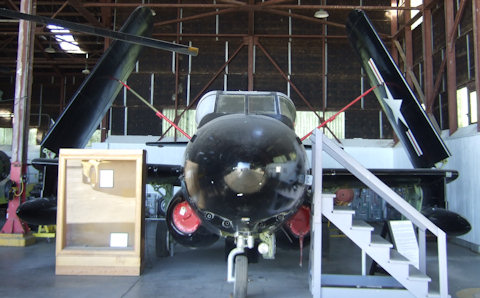
phase and due to its appearance, it earned the nickname, Willie the Whale.
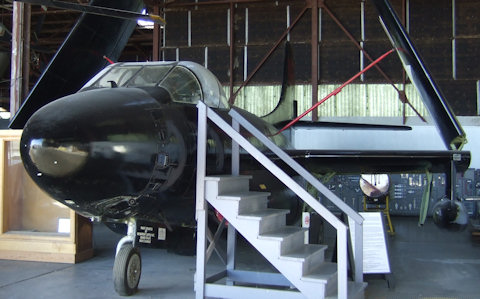
The aircraft has a rotund fuselage, necessary to house the APQ-35 radar
in the nose. The first production F3D-1s went into service in February
1951. These were soon followed by the F3D-2. In all, eight versions of
the Skyknight were built or modified from original airframes.
The Skyknight’s service in frontline Navy units
was short-lived. The F3D-1s did not meet aircraft carrier qualifying
standards. All the
shortcomings were corrected with the F3D-2, but it was not a particularly
popular aircraft aboard the carriers. The downward pointing exhausts
would scorch, and in some cases, burn the wooden flight decks even at
idle speeds. Fleet Composite Squadron VC-4 was the only F3D squadron
to deploy on carrier cruises. By 1956, the Navy planes were in training
and experimental squadrons. F3D service with the US Marine Corps was
a far more successful venture. F3D-2 versions entered the Korean War
during the spring of 1952 with Marine Corps night fighter squadrons.
They escorted US Air Force B-29 Superfortresses on nighttime bombing
raids over North Korea. On 2 November 1952, a Skyknight of Marine Night
Fighter Squadron VMF(N)-513 scored the first shoot down in a jet versus
jet night action, downing a Yak-15 jet fighter. Skyknights scored the
most shoot downs of enemy aircraft by any US Navy or Marine Corps fighter-type
during the Korean War. Two F3Ds were lost in Korea.
Twelve years after the 1953 Korean Armistice, Marines were flying electronic
countermeasures EF-10B Skyknights in the Vietnam War. In 1962, the F3D
designation was changed to F-10. A detachment from Marine Composite Reconnaissance
Squadron VCMJ-1 flew missions over South and North Vietnam and Laos until
its return to the US in 1969. Four EF-10s were lost in Vietnam. The last
Marine Skyknight was retired in May 1970. By then, the only remaining
flying Skyknights were three aircraft bailed to the Raytheon Company
and US Army, performing testing of Army missile defense systems out of
Holloman Air Force Base (AFB), (Alamogordo) New Mexico. One of these
three is the aircraft exhibited here.
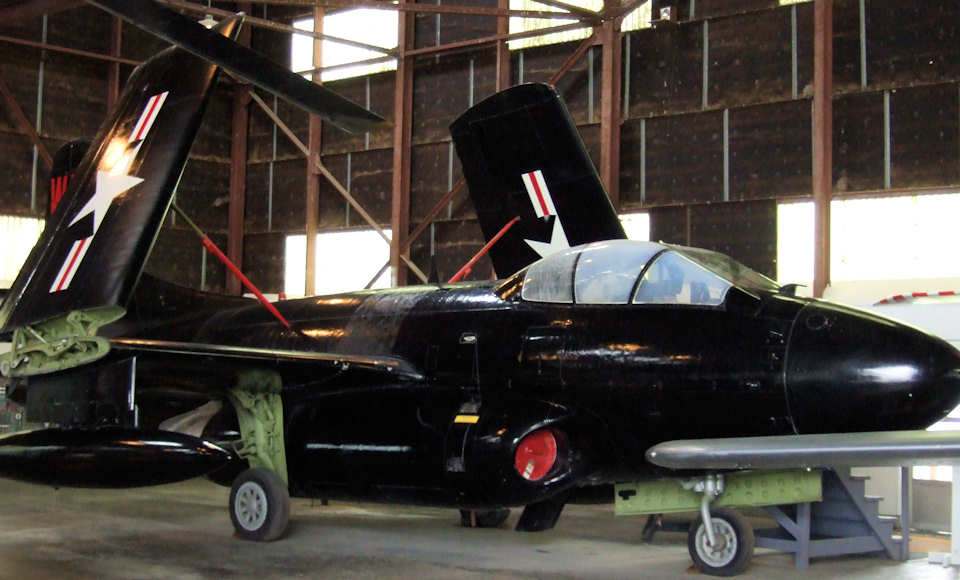
This F3D was built in El Segundo as an F3D-2 and accepted
by the US Navy on March 31, 1953, as Bureau Number 125807. It initially
flew with
Navy Fighter Squadrons. After an Overhaul and Repair (O&R) period
in 1955, it became an F3D-2T2 radar-operator trainer, training fighter
pilots in radar intercept missions. Its final Navy assignment was as
a research and development aircraft at Naval Air Facility China Lake,
(Inyokern) California with periodic visits to O&R facilities. In
September 1962, the aircraft was re-designated a TF-10B. Its naval service
ended in 1968.
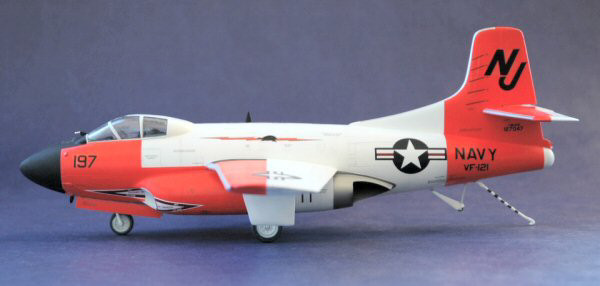
In 1969, this aircraft and two other Skyknights began flying as Raytheon
and US Army test support aircraft. BuNo 125807 flew with a gloss red
and white paint scheme and ARMY on its rear fuselage. A wheels up landing
ended its flying career in 1981. Rather than being repaired, it was used
as a source for spare parts to keep other two F-10s flying.
The General Services Administration granted authorization for Combat
Air Museum to acquire the Skyknight in January 1988. In March 1990, a
crew of six museum volunteers journeyed to Holloman AFB and recovered
125807 for the museum. In order to transport the aircraft over highways,
its wings were cut off as the plane was not built with a removable wing
center section.
The aircraft is painted in Korean War markings of Marine Corps Night
Fighter Squadron VMF(N)-513, the Flying Nightmares, but this particular
Skyknight never flew with the Marine Corps.
This aircraft is on Conditional Transfer to Combat Air Museum from the Kansas
State Agency for Federal Surplus Property
and the General Services Administration.
| Assignments |
|
| April 1953 |
Navy Fleet Composite Squadron VC-4, Naval Air Station (NAS)
Atlantic City, New Jersey
|
| July 1953 |
VC-4, Detachment 41, NAS Quonset Point, Rhode Island
|
| August 1953 |
VC-4, NAS Atlantic City
|
| October 1953 |
Fighter Squadron VF-11 the Red Rippers, NAS Jacksonville,
Florida
|
| November 1953 |
VF-11, NAS Key West, Florida
|
| February 1954 |
Fighter Squadron VF-14 the Top Hatters, NAS Jacksonville,
Florida
|
| July 1955 |
Overhaul & Repair (O&R) NAS Quonset Point, Rhode Island.
Converted to F3D-2T2
|
| March 1956 |
Fleet All-Weather Training Unit, NAS Key West
|
| April 1958 |
O&R, NAS Quonset Point
|
| October 1958 |
Fighter Squadron VF-101 the Grim Reapers, NAS Key West.
|
| October 1959 |
Research, Deployment, Test & Evaluation, Naval Air Facility,
China Lake, California |
| July 1968 |
Stricken from US Navy inventory
|
| 1969-1981 |
US Army missile defense system testing, Raytheon and US Army,
Holloman AFB, New Mexico
|
| March 1990 |
Combat Air Museum |
|
|
| TECHNICAL
NOTES: |
(F3D-2)
|
| Manufacturer: |
Douglas Aircraft Company
|
| Basic Role: |
Carrier-based all-weather night fighter aircraft
|
| Crew: |
Two (Pilot and Radar Observer )
|
| Power Plant: |
Two Westinghouse J34-WE-36/36A turbojets of 3,400 lbs
(1,542kg)
static thrust each
|
| Maximum speed: |
565 mph (909 km/h)
|
| Cruising Speed: |
390 mph (628 km/h)
|
| Range: |
499 miles (803 kms)
|
| Service Ceiling: |
39,900 ft (12,162m)
|
| Combat ceiling: |
39,400 ft (12,009m)
|
| Wingspan: |
50 ft (15.2 m) |
| Length: |
45 ft 6 in (13.9m)
|
| Height: |
16 ft 1 in (4.9m) over tail
|
| Wing Area: |
400 ft² (37.2 m²)
|
| Weight (empty): |
18,160 lbs (8,237kg)
|
| Max Runway: |
28,800 lbs (13,064kg)
|
| Max Catapult: |
27.362 lbs (12,411kg)
|
| Armament: |
Four 20mm cannon; 4,000 lbs (1,814kg) bombs
|
| Serial number: |
US Navy BuNo. 125807 |
|
|