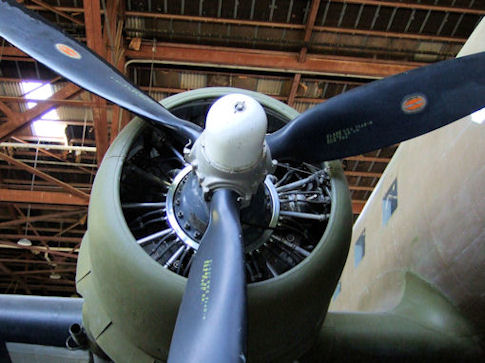
The C-47 was a military derivative of the world famous Douglas DC-3 commercial airliner. The first contract for fully militarized C-47s was let September 16, 1940. Deliveries of DC-3s and DC-3As to US and foreign airlines reached 430 before the US entry into World War II. Manufacture of commercial aircraft was then suspended. The US Army Air Force (USAAF) took over all civil DC-3s and DC-3As still on the production line. Because of the different airline specifications and variety of engines, these aircraft were assigned 22 different designations. Those DC-3s already in US airline service were impressed into the military and included nine different designations. All branches of the US Armed Forces flew the C-47 Skytrain, C-53 Skytrooper, or R4D, as appropriate. The British Commonwealth air forces called the aircraft Dakota. Douglas delivered the last C-47 to the USAAF on October 23, 1945.
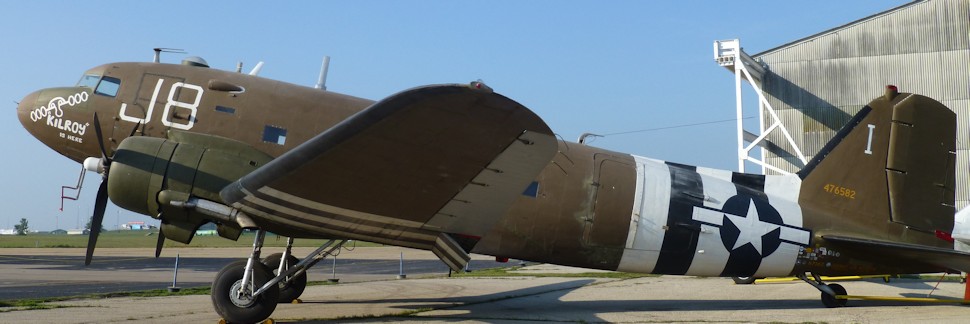
This C-47 was built by the Douglas Aircraft Company in Oklahoma City, Oklahoma and delivered to the USAAF on March 27, 1945. It was originally one of 133 TC-47B-DK trainers. TC-47Bs were equipped as navigational trainers. If you stand behind the tail and look along the top of the plane’s fuselage you will see two round plates between the clear astrodome and the tail. These were positions for two other astrodomes for training navigators in celestial (sun, stars, moon) navigation. In 1947, the aircraft was modified to a C-47D configuration by removing the high altitude blowers from the engines. Two years later, it was converted to a VC-47D staff/VIP (Very Important Person) transport. The C-47 ended its Air Force service in 1966 but continued in US Government service with the Atomic Energy Commission and Department of Agriculture, Animal and Plant Health Inspection Service (USDA/APHIS).
While flying with the USDA, the C-47 took part in the Screwworm Eradication Program along the south Texas-Mexico border. It flew from Moore Field in Mission, Texas and from Tampico, Mexico. Sometime in 1979-1980, the aircraft was released as surplus property and parked at Douglas, Arizona, with other surplus USDA aircraft. Combat Air Museum learned about the plane through the Kansas federal surplus property agency and acquired the plane through the surplus property program in May 1980.
MARKINGS
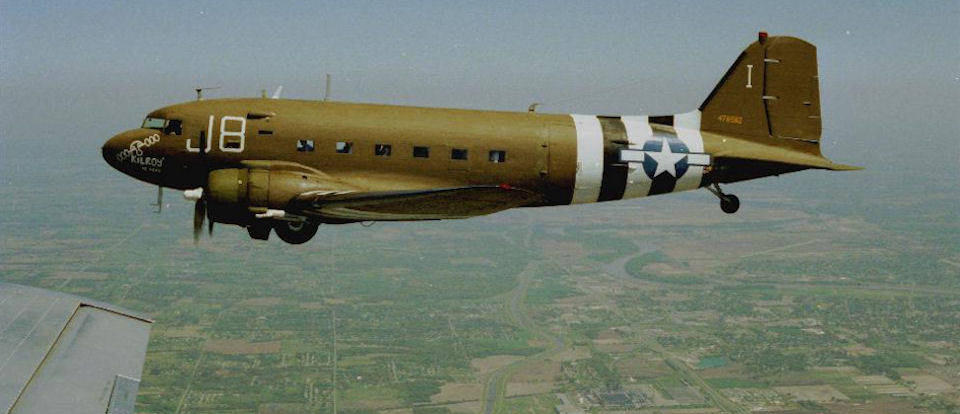
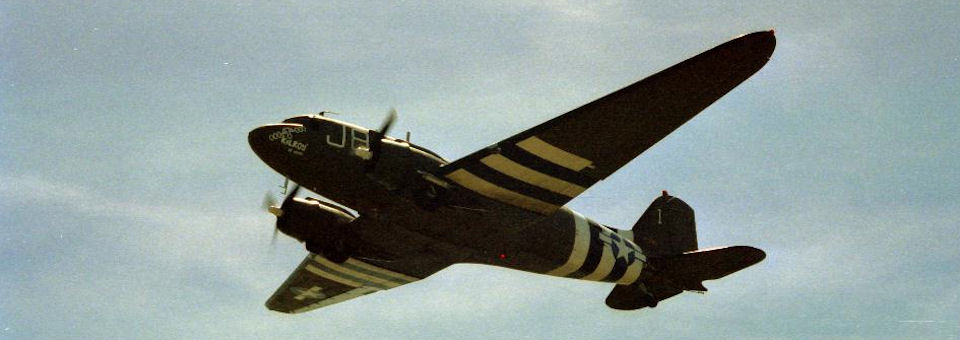
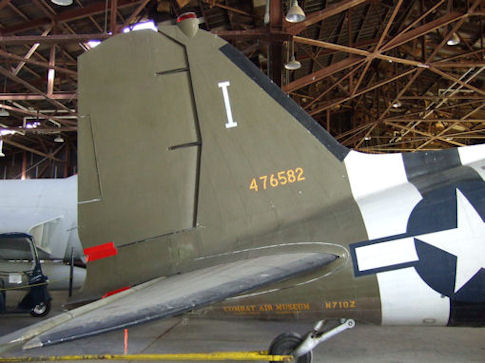
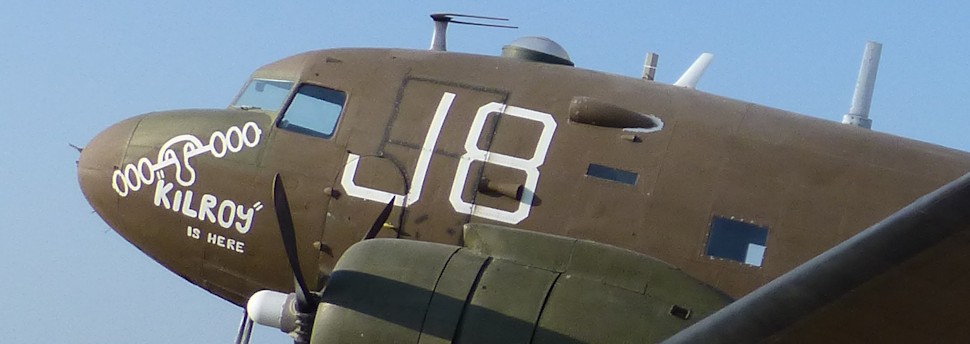
Our C-47 is named after and painted in the markings of a World War II C-47Skytrain. The real Kilroy flew with the 92nd Troop Carrier Squadron, 439th Troop Carrier Group of the IX Troop Carrier Command. The J8 signifies the 92nd squadron. The I signifies the individual radio call letter. The black and white stripes are commonly called “Invasion Stripes.” They were painted on all Allied aircraft taking part in the June 6, 1944, D-Day invasion of Normandy, France, as recognition stripes and were applied less than 24 hours prior to the invasion. The stripes were to warn Allied forces on sea, land, and in the air, to not fire on their own aircraft.
C-47s like Kilroy carried paratroopers of the 82nd “All American” and 101st “Screaming Eagles” Airborne over Normandy in the pre-dawn hours of June 6 to parachute into enemy held territory and secure key positions before the arrival of the invasion fleet. They also towed in airborne glider forces.
This aircraft is owned by Combat Air Museum.
Assignments: |
|
March 1945 |
2517th Base Unit, Ellington Field, (Houston) Texas
|
April 1946 |
3010th Base Unit, Williams Field, (Chandler) Arizona
|
December 1947 |
Modified to C-47D
|
January 1948 |
2533rd Base Unit, Goodfellow Field, (El Paso) Texas
|
February 1948 |
4121st Base Unit, Kelly Field, (San Antonio) Texas
|
August 1948 |
3545th Technical Training Wing (Air Training Command (ATC)), Goodfellow Air Force Base (AFB)
|
December 1948 |
Unit Transferred to Chanute AFB, (Rantoul) Illinois
|
July 1949 |
Modified to VC-47D
|
October 1949 |
3310th Headquarters Squadron (ARC), Scott AFB, (Belleville) Illinois
|
December 1949 |
3750th Technical Training Wing (ATC) Sheppard AFB, (Wichita Falls) Texas
|
August 1951 |
ATC Headquarters, Scott AFB
|
December 1951 |
3310th Technical Training Wing (ATC), Scott AFB
|
August 1957 |
3300th Support Squadron (ATC), Randolph AFB, (San Antonio) Texas
|
June 1960 |
Keesler Technical Training Center, Keesler AFB, (Biloxi) Mississippi
|
July 1962 |
3380th Maintenance and Supply Group (ATC), Keesler AFB
|
April 1963 |
Transferred on loan to Atomic Energy Commission (AEC), Albuquerque, New Mexico.
Records maintained by Wright-Patterson AFB, (Dayton) Ohio
|
June 1966 |
Air Force Logistics Command Headquarters, Wright-Patterson AFB
|
November 1966 |
Dropped from US Air Force inventory. Remained with AEC.
|
December 1972 |
US Department of Agriculture/Animal and Plant Health Inspection Service, Moore Air Base, (Mission) Texas, and Tampico, Mexico.
|
May 1980 |
Transferred to the Combat Air Museum |
| |
|
TECHNICAL NOTES: |
|
Manufacturer: |
Douglas Aircraft Company
|
Basic Role: |
Cargo/Personnel transport: 6,000 lbs (2725 kg) of cargo, or 28 paratroopers, or 14 stretchers
|
Crew: |
Pilot, co-pilot, radio operator
|
Engines: |
Two Pratt & Whitney R-1830 Twin Wasp (1,200 hp; 895kW each) 14-cylinder, air cooled radial engines
|
Max speed: |
224 mph (360km/h)
|
Cruising speed: |
160mph (257km/h)
|
Service ceiling: |
26,400 ft (8,045m)
|
Range:Normal: |
1,600 miles (2,575km) |
Max: |
3,600 miles (5,795km)
|
Span: |
95 ft 6 in (29.11m)
|
Length: |
63 ft 9 in (19.43m)
|
Height: |
17 ft (5.18m)
|
Wing Area: |
987 sq ft (91.7 sq m)
|
Weight - Empty: |
18,135 lbs (8,226kg) |
Loaded: |
26,000 (11,793kg) |
Max: |
31,000 lbs (14,061kg)
|
Armament: |
None
|
Serial number: |
USAF 44-76582 |
|