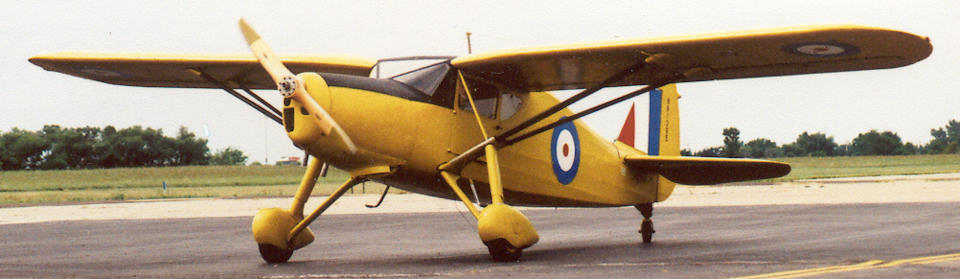
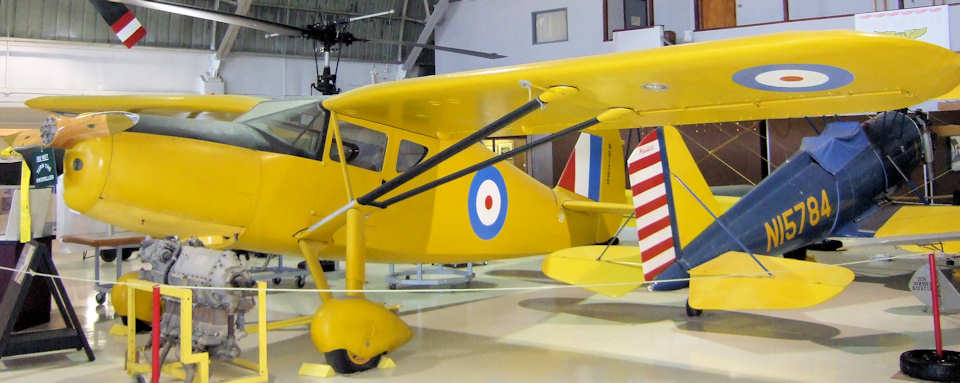
This aircraft was originally built in 1946 under license by Texas Engineering
and Manufacturing Company (TEMCO) in Dallas, Texas, as a Fairchild Model
24-W46 with a Warner Super Scarab 165 air-cooled, radial engine. The aircraft
was in an accident in 1961 and its remains passed through several owners
unrestored before being donated to Combat Air Museum in 1991. Museum
volunteers restored it to a World War II UC-61K Forwarder configuration
with a six-cylinder, inline, air cooled Ranger engine.
In March 1941, with Europe in its 18th month of World War II, the US
Congress authorized the Lend-Lease Act. This Act gave President Franklin
Roosevelt the authority to aid any nation whose defense he felt vital
to the United States. The aid consisted of war materials such as tanks,
airplanes, trucks, and other supplies, including food and services. Although
primarily authorized to aid Great Britain, the Act was extended to China
in April 1941 and to the Soviet Union in September 1941. By the end of
the war, 38 nations had received Lend-Lease aid.
The Fairchild UC-61 series of aircraft were among the various aircraft
sent to Great Britain. The series was based on the popular and successful
civilian Fairchild Model 24 aircraft first flown in 1932. The United
States Army Air Force named the UC-61 the Forwarder, but in British service
the aircraft were named Argus I, II, or III. During World War II, a number
of privately owned Fairchild Model 24s were bought by the US Army and
placed into service.
No Model 24s were
built during 1944 or 1945 as Fairchild was totally involved with military
contracts
building PT-19, PT-23, and PT–27
primary trainers and starting production of the C-82 twin-engine transport.
In order to get to get the popular civilian Model 24 back into production
after World War II, Fairchild created the Fairchild Personal Planes Division
and subcontracted the production of Model 24s to TEMCO. Deliveries of
new Fairchild 24s began in March 1946, but post World War II aviators
had a glut of surplus aircraft to buy cheaply. By the end of 1947 only
218 aircraft had been sold, and production of the famous Model 24 ended
that year. Remaining aircraft were sold off in 1948, and operations of the Fairchild Personal Planes Division ended in 1949.
Combat Air Museum’s
Fairchild 24 received its airworthiness certificate on September 20,
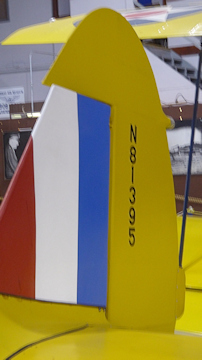
1946 and was registered NC81395. Most of its flying
career was in Kansas. Its last flight log entry was made November 10,
1961 as a 45 minute local flight to MKC (Kansas City, Missouri.) Its
accident was sometime after this. The aircraft’s remains went through
a handful of owners over the next 30 years until Mr. Al Gettings of Blue
Springs, Missouri donated the plane to CAM in February 1991, along with
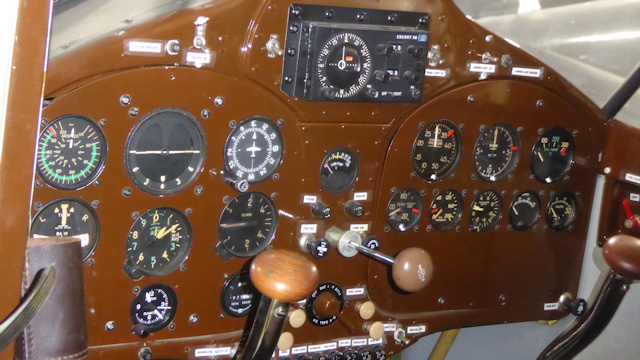
an inline Ranger engine. The Fairchild went through an eight-year rebuild
and restoration. Several museum volunteers assisted in the project, but
Loyd Ellison (1922 – 2003) was the volunteer who did most of the
restoration and rebuild. His work included fabricating the engine cowling
by hand. The Fairchild made its first post-restoration flight on July
9, 1999. It is painted in Royal Air Force markings to represent a World
War II Argus III Lend-Lease aircraft.
In
1991 it was donated to the Combat Air Museum and has since been restored
from the ground
up.
Owners |
|
September 1946 |
Fairchild Personal Planes Division, Dallas, Texas
|
January 21, 1948 |
Fairchild Personal Planes Division, Wichita, Kansas
|
January 22, 1948 |
Bohen-Marie Ferrari, Fort Smith, Arkansas
|
June 24, 1948 |
Acid Engineering Company of Kansas, Lakin, Kansas
|
June 27, 1952 |
Acid Engineers, Inc., Lakin, Kansas
|
June 27, 1952 |
Yingling Aircraft, Inc., Wichita, Kansas
|
June 27, 1952 |
J&J Crop Savers, Lakin, Kansas
|
July 22, 1954 |
Acid Engineers, Inc., Lakin, Kansas
|
November 13, 1954 |
Lawrence O. Tenk, Jr., McPherson, Kansas
|
January 28, 1956 |
Horstman Construction Company, Inc., Olathe, Kansas
|
January 17, 1961 |
William W. Pollard, Parkville, Missouri
|
August 29, 1968 |
Leonard J. Specht, Kansas City, Missouri
|
April 30, 1978 |
Don Good Aircraft Sales, St. Joseph, Missouri
|
June 29, 1978 |
William C. Nichols, Marion, North Carolina
|
December 1984 |
William J. Seltzer, Jr., Concord, North Carolina
|
May 31, 1988 |
Donald W. Sink, Boone, North Carolina
|
January 31, 1991 |
Albert H. Gettings, Blue Springs, Missouri
|
June 20, 1991 |
Combat Air Museum |
| |
|
TECHNICAL
NOTES |
: (UC-61K)
|
Manufacturer: |
Fairchild Aircraft
|
Basic Role: |
Four Seat Light Utility Transport
|
Crew: |
One pilot plus 3 passenger seating capacity |
Power Plant: |
One 200 hp (149kW) Ranger L-440-7 six cylinder, inline, air-cooled
engine
|
Maximum speed: |
133 mph (214km/h)
|
Cruising speed: |
112 mph (180km/h)
|
Max. Range: |
465 miles (748 km)
|
Service Ceiling: |
12,700 ft (3,870 m)
|
Wingspan: |
36 ft 4 in (11.1m)
|
Length: |
26 ft 1 in (8.0m)
|
Height: |
7 ft
7.5 in (2.32m)
|
Wing Area: |
193 ft² (17.96 m²)
|
Weight (empty): |
1,813 lb (822 kg) Loaded: 2,882 lbs (1307kg)
|
Max Takeoff weight: |
2,882 lb (1,307 kg)
|
Armament: |
None
|
Serial number: |
W46295 (FAA Reg. Number N81395) |
|