This
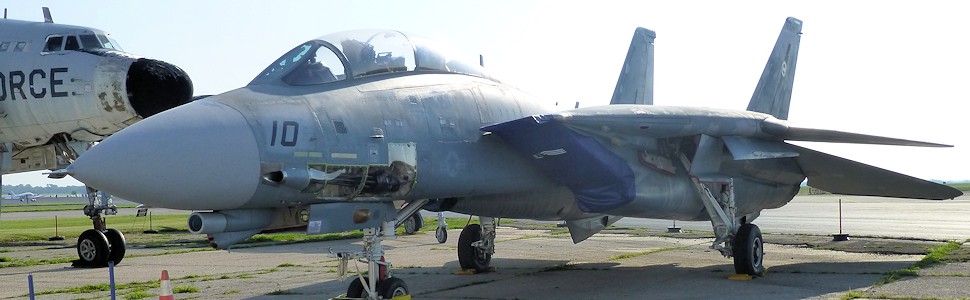
aircraft flew into Forbes Field on October 24, 2003 from the Naval
Strike and Air Warfare Center (NSAWC), Naval Air Station Fallon, Nevada.
NSAWC is home to the US Navy’s Top Gun School for air-to-air
combat instruction. BuNo161615’s final flight came 20 years after
it made its first flight, in October 1983.
Because a potential adversary of the United States has a number of
this model of Tomcat, the Pratt and Whitney TF30 turbofan engines were
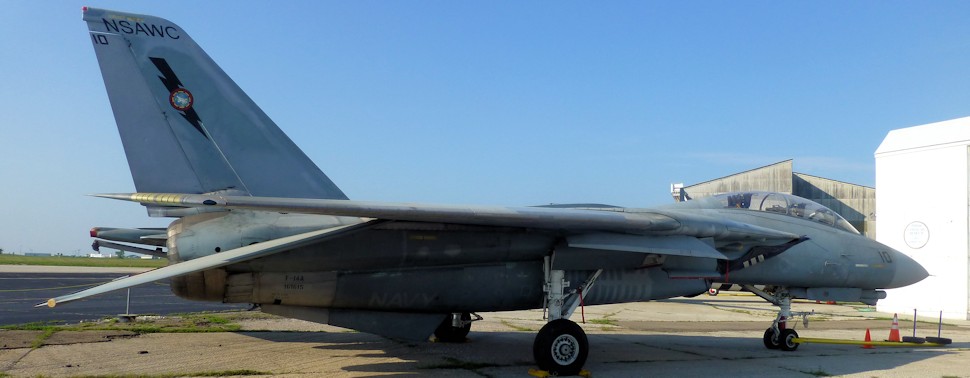
removed for destruction before placing it on exhibit. The aircraft
is exhibited as it would be on the flight deck or hangar deck of an
aircraft carrier, with its wings in the over-swept position for minimum
wingspan.
Grumman Corporation, Aircraft Systems Division, built the Tomcat at
its Calverton, Long Island, New York plant and delivered it to the
US Naval Plant Representative Officer in October 1983. It was assigned
to its first fighter squadron, VF-124, in December 1983.
Deliveries
of Tomcats to the US Navy began in June 1972. With its variable sweep
wing design,
the F-14 became the Navy’s premier
fighter, the first of the super fighters. F-14’s were phased
out of service by the end of 2006. They were still a world premier
fighter, but the number of maintenance hours required for each hour
of flight played significantly in their retirement. The Boeing/McDonnell-Douglas
F/A-18E/F Super Hornet is the F-14’s replacement.
This aircraft
is on loan from the National Museum of Naval Aviation at Pensacola,
Florida
Assignments: |
|
December 1983 |
Fighter Squadron VF-124 Gunfighters |
January 1984 |
Fighter Squadron VF-21 Freelancers |
June 1988 |
Fighter Squadron VF-111 Sundowners |
January 1990 |
Fighter Squadron VF-211 Checkmates |
June 1998 |
Fighter Squadron VF-41 Black Aces |
November 2001 |
Naval Strike and Air Warfare Center (Top Gun), Naval
Air Station
Fallon, Nevada |
October 24, 2003 |
Combat Air Museum |
|
|
TECHNICAL
NOTES: |
(F-14A)
|
Manufacturer: |
Grumman |
Basic Role: |
Carrier-borne air superiority fighter
|
Crew: |
Pilot and Naval Flight Officer (Radar Intercept Officer) in tandem
|
Power Plant: |
Two 20,900 lb (93kN) static thrust Pratt & Whitney TF30-P-412A
or four 14A turbofans
|
Maximum speed: |
Mach 2.3; 1,544 mph (2,485km/hr)
|
Cruising speed: |
633 mph (1,019km/hr)
|
Max. Range: |
2,000 miles (3,219km)
|
Service ceiling: |
68,900 ft (21,000m)
|
Range (combat radius): |
765 miles (1,231km)
|
Wingspan (max spread): |
64 ft 1 ½ in (19.55m)
|
Span (fully swept): |
38 ft 2 ½ in (11.65m)
|
Span (over-swept): |
33 ft 3 ½ in (10.15m)
|
Length: |
62 ft 8 in (19.10m)
|
Height: |
16 ft. (4.88m) Wing Area: 565 sq ft (52.49sq. m)
|
Weights (empty): |
40,100 lb (18,189kg)
|
Normal Takeoff Weight: |
58,715 lb (26,633kg)
|
Armament: |
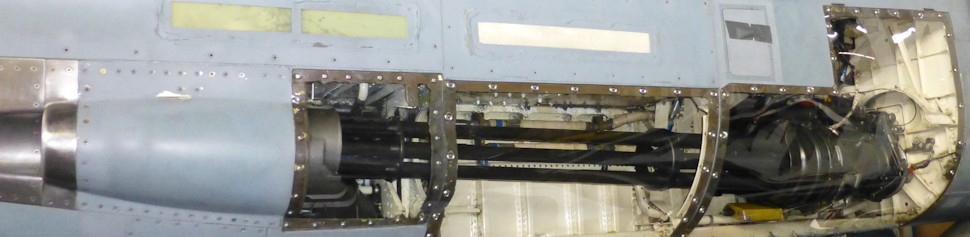
One M-61A1 20-mm cannon.
Four AIM-7 Sparrow plus four AIM-9 Sidewinder air-to-air missiles or six AIM-Phoenix
air-to-air missiles.
|
Serial Number: |
US Navy BuNo 161615 |