The F-4 Phantom II was developed as a US Navy/Marine Corps carrier and land based interceptor and entered service in 1961. At this time the US Air Force (USAF) accepted several Phantoms for evaluation in the interceptor, attack, and close air support roles. The USAF officially accepted the Phantom II as its newest fighter on March 30, 1962, and the F-4C became operational in mid-1963.
USAF F-4s deployed to Vietnam in early 1965. Three USAF pilots became aces in the Vietnam War. All three did so in the F-4. The Phantom II was also used in the air-to-ground role in Vietnam. In this role, it could carry twice the normal bomb load of a World War II B-17.
Over 5,200 Phantoms were built when production ended in 1981. The F-4 also served with the air forces of 10 other countries. The Grumman F-14 Tomcat and McDonnell-Douglas F/A-18 Hornet replaced Navy and Marine Corps Phantoms. The McDonnell-Douglas F-15 Eagle and General Dynamics F-16 Falcon replaced Air Force Phantoms. Today, the Navy and Air Force use the Phantom II in their drone programs as full scale targets.
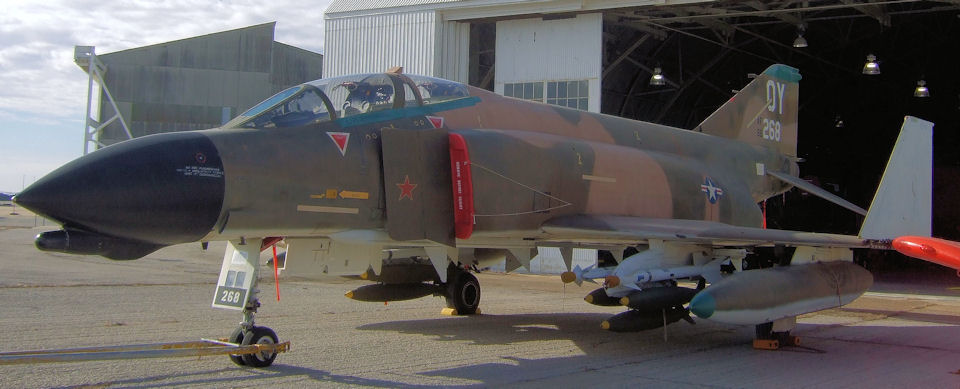
The Museum's F-4D was built by McDonnell Aircraft at St. Louis, Missouri and delivered to the USAF on January 12, 1967. It served a tour in Southeast Asia, and on October 12, 1972, Captains John A. Madden (Pilot) and Larry Pettit (WSO) were credited for downing a North Vietnamese MiG-21 fighter. They accomplished this by maneuver alone, causing the enemy fighter to fly into the ground while trying to evade the Phantom.
This aircraft ended its flying career with the 184th Tactical Fighter Group (TFG), Kansas Air National Guard at McConnell Air Force Base in Wichita, Kansas.
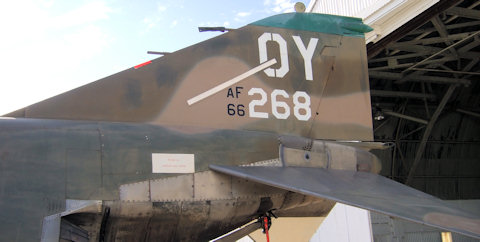
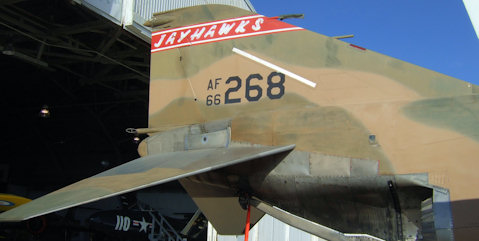
66-268 arrived at CAM March 16, 1990. A dedication ceremony was held April 27, 1990 with Major Larry Pettit (USAF, retired) and members of the 184th TFG attending as guests of honor. It is painted in the Southeast Asia camouflage scheme and has the markings of the 555th Tactical Fighter Squadron (the Triple Nickels) painted on the left side of the vertical fin. The markings of the 184th Tactical Fighter Group are painted on the right side of the vertical fin.
WICHITA LINEMAN
During 66-268’s career with the 184th Tactical Fighter Group, Kansas Air National Guard, it was flown to the Air National Guard Smoky Hill gunnery and bombing range southwest of Salina, Kansas for training. After a gunnery run the pilot stayed too low for too long coming out of the target area and flew through a set of power lines. The aircraft recovered safely and returned to McConnell Air Force Base. There was extensive damage to the leading edges of 268’s wings and pylon stations and bits and pieces of wire were hanging from the bottom of the jet. From that time forward 268 became the Wichita Lineman, named for a popular country song. Technical Sergeant Robert Johnston of the 184th did the original artwork on the nose gear door and restored it for the Museum in the summer of 1999.
This aircraft is on loan from the National Museum of the United States Air Force, Dayton, Ohio.
Assignments: |
|
January 1967 |
15th Tactical Fighter Wing (TFW), Tactical Air Command (TAC), MacDill Air Force Base (AFB), (Tampa) Florida. Deployed to Nellis AFB, (Las Vegas) Nevada)
|
June 1968 |
4531st TFW, TAC, Homestead AFB, (Homestead) Florida
|
Dec 1969 |
475th TFW, Pacific Air Forces (PACAF), Misawa Air Base (AB), (Misawa) Japan
|
March 1971 |
3rd TFW, PACAF, Kunsan AB, (Kunsan City) South Korea (Deployed to DaNang AB, South Vietnam and Korat Royal Thai Air Force Base (RTAFB), (Nakhon Ratchasima or Korat) Thailand
|
Sept 1972 |
555th Tactical Fighter Squadron 432nd Tactical Reconnaissance Wing, PACAF, Udorn RTAFB, (Udon Thani) Thailand
|
January 1974 |
8th TFW, PACAF, Ubon RTAFB, (Ubon Ratchathani) Thailand
|
August 1975 |
18th TFW, PACAF, Kadena AB, (Naha) Okinawa
|
October 1979 |
Ogden Air Logistics Center Hill AFB (Ogden) Utah
|
March 1980 |
184th Tactical Fighter Group, Kansas Air National Guard, McConnell AFB (Wichita) Kansas
|
Sept 1987 |
Dropped from USAF inventory by transfer to school or museum
|
Mar 16, 1990 |
Combat Air Museum |
|
|
TECHNICAL
NOTES: |
|
Manufacturer: |
McDonnell Aircraft |
Basic Role: |
Supersonic, all-weather, tactical aircraft (fighter-bomber or
interceptor)
|
Crew: |
Pilot and Weapons System Operator (WSO)
|
Engines: |
Two General Electric J79-GE-15 of 10,900 lbs. (4,944kg) static thrust
each with 17,000 lbs (7,711kg) static thrust each with afterburners
|
Maximum speed: |
1,432 mph (2,305km/hr) @ 42,000 ft (12,802m)
|
Cruising Speed: |
587 mph (945km/hr)
|
Range (combat): |
502 miles (808km) Max: 1,844 miles (2,968km) without aerial
refueling.
|
Service Ceiling: |
55,850 ft (17, 023m)
|
Wingspan: |
38 ft. 5 in (11.7m) (27 ft. 6 in. folded)
|
Length: |
58 ft 3 in (17.8m)
|
Height: |
16 ft 5 in (5m)
|
Wing area: |
530 sq ft (49.2sq m)
|
Weight (empty): |
28,873 lbs. (13,097kg) Combat: 38,781 lbs. (17,591kg)
|
Weight (gross): |
58,000 lbs (26,308kg)
|
Armament: |
Up to four Sidewinder AIM-9 missiles; up to four Sparrow AIM-7 missiles;
16,000 lbs. (7,258kg) of externally
carried bombs, rockets, or 20mm cannon pods in various combinations
|
Serial number: |
USAF 66-0268 |
|