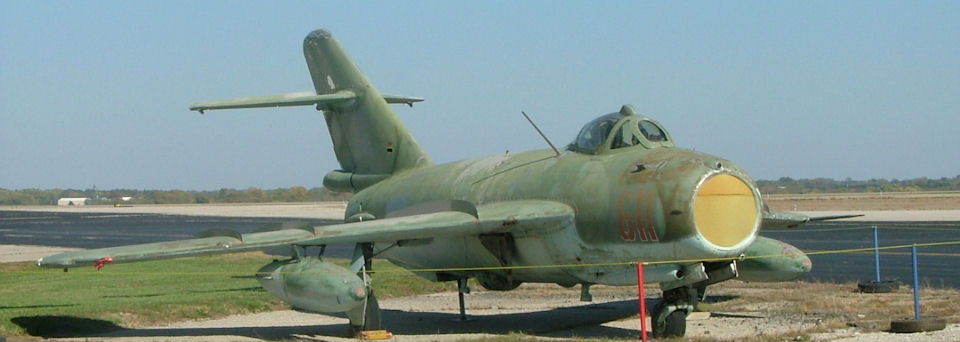
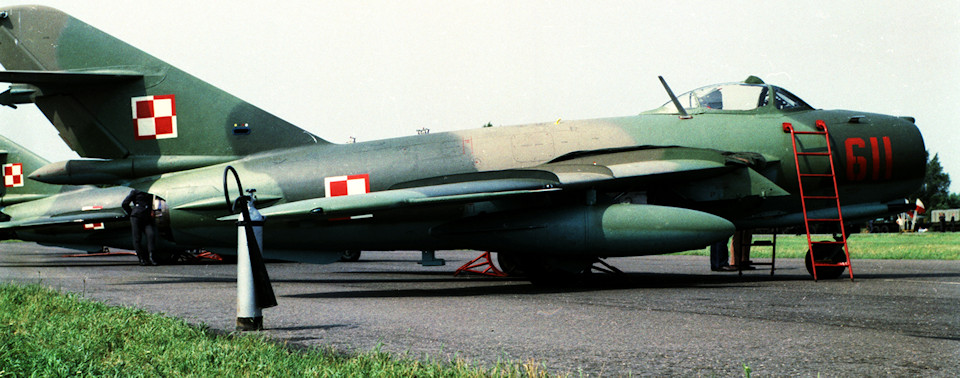
This jet fighter is a Lim-6R, a Polish-built version of the Soviet Mikoyan-Gurevich MiG-17 that was given the NATO (North Atlantic Treaty Organization) code
name 'Fresco'. The Lim-6R was a photoreconnaissance aircraft that was also used as a fighter-bomber. Its tactical number, Red 611 (Polish Air Force markings 1J 06-11) refers to this aircraft.
The MiG-17 was an upgraded and improved version of the Korean War-era Soviet
MiG-15. It was designed in 1949 and first flown in 1950. The type entered service in 1952 eventually replacing the MiG-15 as the Soviet's
main fighter. Although the Fresco was not supersonic in level flight, it could break the sound barrier in a dive. The early MiG-17s had improved
versions of the MiG-15's Klimov VK-1 turbojet. The greatly redesigned VK-1F had an afterburner requiring a longer fuselage to accommodate the
afterburner section. The tail was changed and another fence was added on each wing to improve the stability of the aircraft at high speeds.
The MiG-17's wing has two different sweep angles on the leading edge. The resulting bend in the middle of the wing led to it being referred
to as a "sickle wing". The change in wing angle may not be noticed until you sight along the leading edge of the wing; then the
bend is quite obvious. The appearance of the MiG-17 was so similar to the MiG-15 that Western military personnel initially thought the MiG-17
another model of the MiG-15. Some 8,000 MiG-17s were manufactured between 1952 and 1958 and they were in service in the Warsaw Pact Air Forces
into the 1990s. Over 30 countries flew the various MiG-17 types. The North Vietnamese Air Force flew MiG-17s in combat against US and allied
aircraft during the Vietnam War.
Polish production of the MiG-17 took place at the WSK-Mielec factory in southeastern Poland beginning
in November, 1956 with the Lim-5, then the Lim-6, with variations of each type. Work on the last major production model, the Lim-6bis variant,
began in 1963 and lasted until 1964. This version reverted to an original MiG-17F wing design and added an underwing pylon on each inboard wing
panel. A few of the Lim-6bis, including Red 611, were modified for reconnaissance by addition of an AFA-39 camera pod. This pod is on the lower
right side of the aircraft's mid-fuselage.
The Lim-6bis and Lim-6R used a drogue parachute first seen on the basic Lim-6. The bullet-shaped
housing for the parachute is located at the base of the rudder and is found only on Polish-built MIG-17s. Poland was the last country to build
the MiG-17 design anywhere in the world, since Soviet and Chinese production ended in the late 1950's.
The canopy is so small the pilot wore a leather helmet rather than a modern hard helmet. Pilots often wore leather
jackets, too, making them look more like World War II pilots than modern era jet fighter pilots. The cockpit is also quite small. The gun sight takes up most of the space in the front of the canopy, restricting the pilot's view. In addition, a rocket control panel was added to the cockpit when the plane was equipped with rocket pods. Even in the Polish planes, most of the cockpit instruments are written in Russian Cyrillic.
Red 611 was manufactured in late 1963, with a service entry date of 16 January 1964 with the 21st Tactical Reconnaissance Regiment (21PLRT). Red 611 was originally built as a Lim-5, converted to a Lim-6R (reconnaissance) version and returned to Unit 21PLRT at Sochaczew in late 1964 - February 1965. There is a long gap in the data on 611, the next date being 24 June 1982 when it came out of Military Aircraft Repair Works No.2 (WZL-2) at Bydgoszoz and delivered to 45-PLMB (45th Fighter-Bomber Regiment). It probably remained with this unit until official withdrawal on 13 June 1988 and was parked on Bydgoszoz airfield, where it was reported as being in 1991. This aircraft was acquired by the Military Aircraft Restoration Corporation (M.A.R.C.) probably in late 1991 or in 1992 and shipped to the USA. Sometime later it was shipped to, and stored at, the Combat Air Museum. Red 611 was donated to the Museum by M.A.R.C. in 2019.
This aircraft
is owned by the Combat Air Museum and will be under restoration (exterior paintwork/some bodywork) shortly.