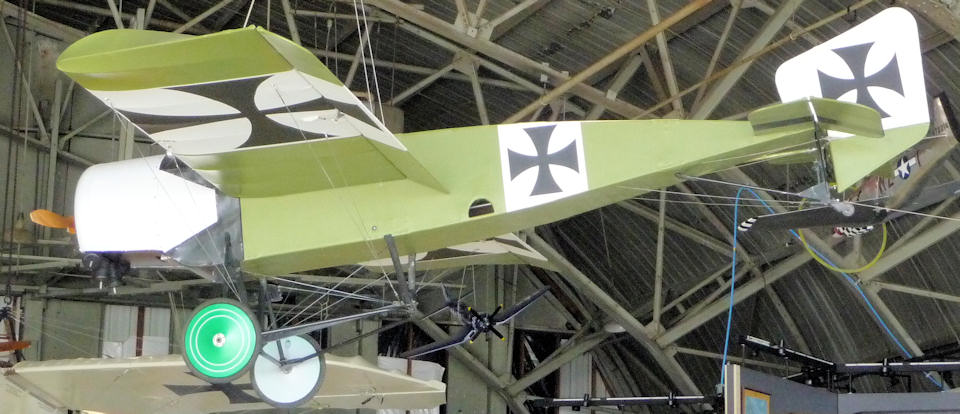
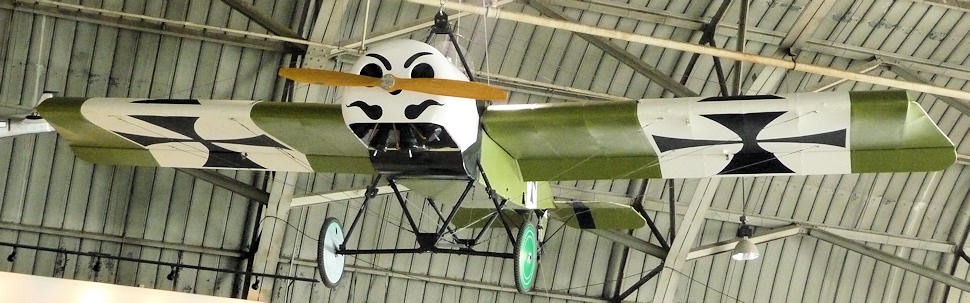

The Pfalz E1 was a WWI shoulder-wing monoplane (actually a license-built French Morane-Saulinier type “H”, slightly modified) with a rotary engine, produced in the Speyer am Rhein located Pfalz factory, run by three Eversbusch brothers, Alfred, Walter and Ernst, until the untimely death of Walter in a flying accident on June 1st, 1916. The 3 brothers designed and test flew the machines they built.
At first, the E-type was used as an unarmed scout but, with the success of the Fokker synchronizing gear in 1915, a similar installation was tried on the Pflaz monoplane, which then went into production as the Pfalz E1.
Some 60 examples were built before the next variant was produced (Pfalz EII), which was little more than an E1 with a 100 h.p. Oberursel engine fitted.
Due to their great similarity in appearance to the Fokker monoplanes, the Pfalz machines automatically became “Fokkers” to the Allies in WWI. It was only through the shape of their steering surfaces that the types could be positively identified. They differed little in size and weight.
In contrast, the Pfalz monoplane differed considerably structurally from the Fokker design. The Pfalz had a completely wooden airframe instead of the Fokker's welded steel tube fuselage.
More efficient and powerful biplanes came into service, and the operational life of the Pfalz E types was comparatively short on the Western Front. They continued to serve on the Eastern Front as trainers.*
The flying scale model Pfalz was donated to the Museum in Nov 2009 by the builder/owner Robert Baslee of Airdrome Aeroplanes in Holden, MO. Baslee has built 20 different designs of World War I airplanes and he built two of the planes that appeared in "Amelia", the 2009 movie about the pioneer pilot Amelia Earhart.
|
Technical data Pfalz E1 (Original Design: Full Scale)* |
| Designation: Single-seat fighting scout |
| Manufacturer: Pfalz Flugseug-Werke G.m.b.H. Speyer am Rhein (Pfal.) |
| Power Plant: One 80 h.p. Oberusel U O 9 cylinder rotary engine |
| Dimensions: |
| Span: 30 ft. 4 5/8 in (9.26m) |
| Length: 20 ft. 8 in. (6.3m) |
| Height: 8 ft. 4 3/8 in. (2.55m) |
| Wing Area: 151.2 sq1. ft. (14 sq m) |
| Weights: |
| Empty: 759 lb. (345 kg) |
| Loaded: 1,177 lb. (535kg) |
| Performance: |
| Maximum speed: 90.6 m.p.h. (145 km/hr) |
| Climb: 2,624 ft. (800m) in three minutes 6,560 ft. (2,000m) in 12 minutes |
| Duration: circa two hours |
| Armament: One Spandau machine gun firing forward. |
| *Aircraft description and technical data taken from "German Aircraft of the First World War" by Peter Gray & Owen Thetford |
 |